
Benjamin Filtjens Human Movement Intelligence

Research project

AID-FOG

Complementing laboratory snapshots with freezing-of-gait monitoring at home using wearable sensing and first-person video.

Research Collaboration Movement in clinical practiceLearning from human movement
Role
Co-Investigator
Award / reference year
2024
Funders
Michael J. Fox Foundation for Parkinson’s Research
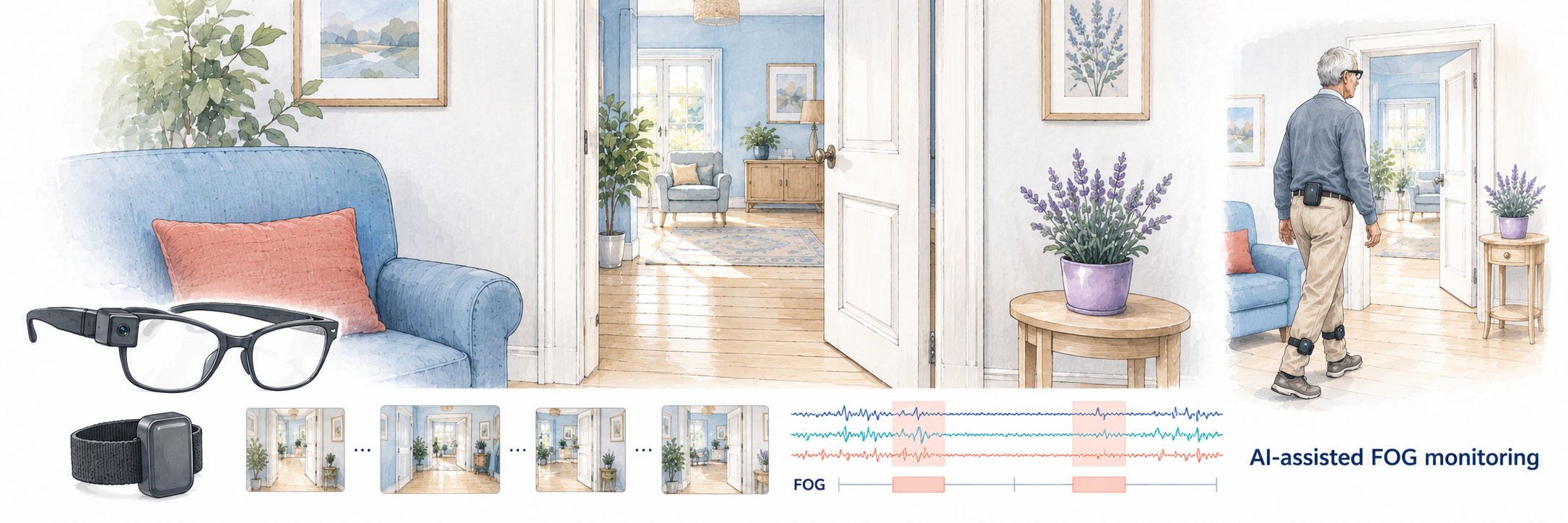
A first-person home doorway view with camera glasses, an IMU, synchronized video thumbnails and movement traces, a FOG-event timeline, and a small inset of an older wearer.

First-person home video and wearable IMU signals support AI-assisted freezing-of-gait monitoring. Schematic illustration; the signals and event intervals are illustrative.

Illustration developed for AID-FOG · View full-size image ↗

From clinical assessment to everyday life

Laboratory assessments provide a controlled snapshot of walking, but a limited view of freezing of gait in everyday life. At home, activities, environments and recording conditions are less standardized, making assessment more complex.

AID-FOG extends the methods developed through FOG-IT towards home monitoring. Our work explores how wearable inertial measurement units (IMUs) and first-person video can support AI-assisted assessment of movement and its environmental context. The aim is to complement laboratory observations with a fuller picture of when and where freezing occurs during daily life.

Related work

Publications

2026

Preprint

Towards Context-Aware Clinical Motion Understanding in Daily Living at Home: Freezing of Gait Detection with Egocentric Vision

Stefanova V, Lamsal D, Genbrugge M, Yudayev M, Schlenstedt C, Gilat M, Vanrumste B, Filtjens B

arXiv preprint arXiv:2608.13283, 2026

MoCha at ECCV 2026, in press; linked version is a preprint.

Citation

Stefanova V, Lamsal D, Genbrugge M, Yudayev M, Schlenstedt C, Gilat M, Vanrumste B, Filtjens B (2026). Towards Context-Aware Clinical Motion Understanding in Daily Living at Home: Freezing of Gait Detection with Egocentric Vision. arXiv preprint arXiv:2608.13283, 2026. https://doi.org/10.48550/arXiv.2608.13283